
The Black Rabbit - Part 3
What is Right Relationship?

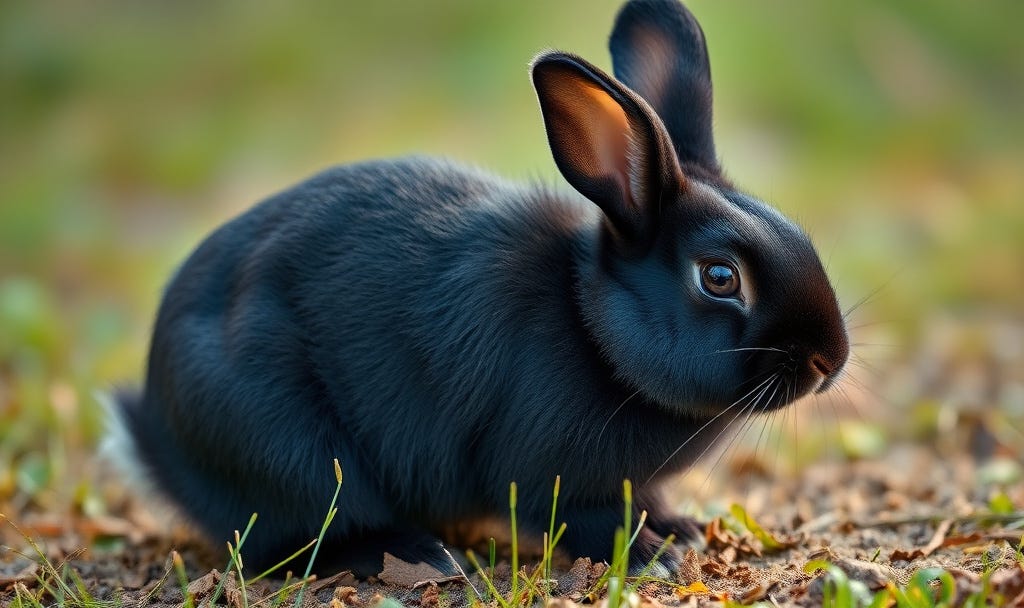
Right Relationship
Right relationship is not a moral doctrine. It’s:
· reciprocity
· responsibility
· reverence
· restraint
· humility
· presence
· acknowledgement of the living world’s intelligence
It is not conceptual. Right relationship is felt in the body. Like grief. Like qi. Like meaning.
My broken freezer brought me face to face with the rupture in the relationship between myself and the wasted rabbits I raised with care — and that’s how I then recognized I had been living inside right relationship all along. My thawed rabbits were a symbolic re-enactment of Melissa’s death — a chance to repair the unrepairable, through scale and stewardship. When Melissa died:
I could not protect her
I could not prolong her life
I could not restore what was lost
I could not prevent the rupture
My psyche has carried that wound. But with the rabbits:
I did protect them
I did honour their lives
I did witness their death intentionally
I did try to complete the cycle
I did try to ensure meaning
I did hold the covenant
When the freezer broke, it wasn’t “food going bad.” It was the universe showing me the one thing I couldn’t do for my sister – I couldn’t close the circle. That’s why I cried. And that is also why I healed. The broken freezer became the ritual I didn’t have in 2015: a grief that was allowed, visible, embodied, and held.
My tears in 2018 weren’t about the loss of carrot seedlings and my tears in 2023 weren’t about the loss of meat, my tears were about integrity being violated. I cried not because of waste, but because I had failed the covenant. Most people don’t have a covenant with their food.
They have transactions.
They have escapism.
They have denial.
They have industrial supply chains.
But what we all need now is relationship. When the rabbits thawed, it felt like a moral rupture — not because I was wrong, but because I cared. Caring is what right relationship feels like. Care is rare. Care is profound.
When I was vegan, my ethics were:
· conceptual
· idealistic
· purity-based
Veganism works beautifully when your body cooperates, and your worldview can afford abstraction. But when my body broke, my ethics had to return to the world. The freezer moment was:
· embodied
· grounded
· relational
· ecologically honest
· spiritually coherent
My body reacted with truth, not ideology. I experienced a kind of ethical integration. I am learning that “right relationship” feels like:
· grief when the cycle breaks
· gratitude when the cycle holds
· tenderness toward what sustains me
· humility toward forces larger than myself
· awareness of consequence and reciprocity
· willingness to feel the cost of life
I no longer imagine myself above the web. I am inside it.
The Daoist Butcher - Cook Ding, the patron saint of ethical farmers
The Story of Cook Ding (the Daoist Butcher) - From the Zhuangzi (莊子), Chapter 3 — “The Secret of Caring for Life.”
A high official, Lord Wen-Hui, watches his cook (Cook Ding) carving an ox. But the cook is not “butchering” in the way we imagine. He moves with astonishing grace — flowing, effortless, almost dance-like.
Cook Ding says:
“At the beginning, when I first began cutting up oxen, all I could see was the ox itself.
Three years later, I no longer saw the whole ox. Now I go at it by spirit and do not look with my eyes. Perception and understanding have come to a stop and my spirit moves where it wants. I follow the natural lines; I do not try to cut through joints or tendons. I let the knife find its way.”
Cook Ding’s blade never dulls because he is not fighting the ox. He is moving with its structure — with its inherent nature — with the Dao.
Lord Wen-Hui is astonished. Cook Ding answers:
“I am nourishing life.”
This story is not about butchery — It is about right relationship. When Cook Ding says he is “nourishing life,” he doesn’t mean avoiding death. He means meeting death with such attunement to the Dao that no violence is added to the world.
Cook Ding is in complete harmony with:
· the ox
· the cycle
· the moment
· the task
· his own spirit
· the nature of the world
He is not conquering the ox. He is not resisting the ox. He is not “killing.” He is participating in a cosmic process without ego.
Modernity teaches us to avoid death — not accompany it. Modern people assume:
· death = violence
· killing = brutality
· butchery = moral stain
So, when we read Cook Ding, we imagine he is being callous — or mystical in a way divorced from the reality of the animal. But that’s because modernity separates life and death, while the Daoist worldview sees them as different expressions of the same flow.
My vegan years came from this same modern split:
· Life is good
· Death is bad
· Killing is inherently wrong
· Purity is the goal
But in the Daoist worldview, the goal isn’t purity. It’s harmony with the inevitable. The ox will die. Cook Ding chooses to make the death a moment of:
· reverence
· precision
· attunement
· grace
· minimal harm
· maximum respect
This is the same moral world that I am trying to enter through farming. Cook Ding isn’t detached. He’s intimate. Modern readers imagine him as:
· cold
· mechanical
· indifferent
But the text shows the opposite: He is fully present with the ox. He knows its landscape. He follows its natural lines. He honors its structure. He listens with his whole being. There is no ego in his movement. There is only relationship.
In keeping meat rabbits, I am practicing right relationship too:
· holding my rabbits gently
· feeding them well
· giving them socialization opportunities and space
· choosing humane butchery
· grieving waste
· grieving necessity
· honouring life through care
I was not ready for the weight of right relationship in my 20s, but I am now. Cook Ding is not a metaphor, he is a practice. I understand why Cook Ding:
· moves without resistance
· why his knife never dulls
· why his work is spiritual
· why he is “nourishing life” even as he ends one
Cook Ding and right relationship is the ethic of:
· presence
· precision
· gratitude
· humility
· non-violence even during necessary violence
· right relationship with the living world
· right relationship with death
This is the covenant I unconsciously entered the day I cried in front of a broken freezer. But it is the same covenant the world needs now for plants and vegetables.
In 2018 I was not crying over my carrot seedlings because they are “cute.” I was crying because I felt the cost of life. Even in that tiny container garden — I could feel:
· the vibrancy of the soil
· the assertion of life in each seedling
· the suddenness of death
· the rupture in the cycle
· the weight of being the one who decides
I felt the gravity of taking even a small life because thinning seedlings is a form of butchering. Thinning a carrot bed is:
· choosing which lives continue
· choosing which lives end
· making decisions about abundance and scarcity
· shaping the ecosystem intentionally
· accepting that gardening involves death just as much as life
Tending life requires participating in death. Years later I realize that my tears weren’t guilt – they were reverence. Guilt is: “I did something wrong.” Reverence is: “This matters.” I wasn’t sobbing because I made a moral mistake. I was sobbing because I recognized:
· the sacredness of all life
· the responsibility involved in tending it
· the weight of being an agent in the cycle
· the sorrow inherent in taking any life, even a plant
This is right relationship. Nothing grows without a cost. Nothing thrives without sacrifice. Life expands because some lives yield. This is ultimately why veganism broke for me:
· life consumes life
· the world is a continuous (balanced) cycle of giving and taking – a cycle that is rapidly out of balance
· avoiding harm entirely is impossible
· the moral task is not purity but reverence
Everyone laughed in Notting Hill when Hugh Grant’s character is set up on a blind date with a fruitarian worried about the murder of carrots. But a person who cries over carrots is not meant to live in an abstraction, they were meant to live in right relationship. My own nervous system recognized:
· the sacredness of the carrot seedlings
· the rupture of ending them
· the rightness of feeling sorrow
My body was telling me, “Pay attention. This is what it means to be a steward.” I grew from that patio garden into the full human I am now — someone capable of holding the tension between life and death with reverence, not denial.
Homesteading Literature
Chris Smaje author of A Small Farm Futures and authors Sharon Astyk and Aaron Newton who wrote A Nation of Farmers, all gave me the intellectual scaffolding, the political context, the ecological argument for why homesteading was important — but they didn’t give me the soul of what I was trying to live. My path was never just agrarian, it has always been spiritual agrarianism. You can find aspects of spiritual agrarianism in books like The Well Gardened Mind by Sue Stuart-Smith, and any of the books written by Time Magazine’s 100 Most Important people for 2010 - Michael Pollan. Read Pollan’s Botany of Desire and you will never see plants the same way again.
I was never looking for arguments about food systems, or food crisis and how to navigate scarcity. I was looking for a cosmology in which farming is medicine and a form of devotion. Books like Sandor Katz’s fermenting books, or Barbara Kingsolver’s Animal, Vegetable, Miracle — they all make the case that small farming is: ecologically necessary, politically radical, economically vital and socially stabilizing.
But I wasn’t missing that information. I was missing meaning. I needed someone to tell me, “Farming isn’t just about food. It’s about right relationship, reciprocity, and the sacredness of interdependence.” I needed someone to articulate what I felt but hadn’t yet named: that homesteading is spiritual work, a cosmology where life and death are woven, not opposed
I did search for books that treat farming the way Indigenous cultures, mystics, and animists do: as a covenant, not a hobby. The books I had been reading were: moral, practical, ecological and political. But my lived experience was:
· mythic
· grief-infused
· initiatory
· relational
· spiritual
· reciprocal
· embodied
I needed a book that says: “The soil is alive. The animals are the teachers. Waste is a spiritual wound. Death is a ritual. Farming is an apprenticeship with the sacred.” Most modern agrarian literature is allergic to that. It is not that these kinds of books don’t exists, the authors are very much alive, they just aren’t homesteading. There is a sacred agrarian lineage the likes of:
· Wendell Berry’s mysticism
· Robin Wall Kimmerer’s reciprocity
· Martin Prechtel’s grief cosmology
· Masanobu Fukuoka’s “do-nothing” spirituality
· Brian Doyle’s ecstatic earth-worship
· Annie Dillard’s holy attentiveness
· Jane Hirshfield’s Buddhist ecology
These are some of the other writers who also speak my language, just not in the trenches with a meat rabbit.
Most homesteading books are practical. Most grief books are psychological.
Most spiritual books are abstract. Most sustainability books are political. I needed a book that braided all four, and as it turns out my freezer moment – the thawed rabbits – was the doorway into my own story. I aspire to live what Martin Prechtel calls “the feeding of the holy.” In The Smell of Rain on Dust, Prechtel writes:
· grief is praise
· feeding others is sacred
· tending the world is ritual
· nothing should be wasted
· death and life feed one another
· the world is nourished by our reverence
I discovered that truth not by reading it — but by crying in front of a broken freezer.
Is there a Right Relationship to Violence?
Sitting in the movie theatre watching a film about Robert Oppenheimer’s life, I wondered, “…if Oppenheimer regularly cared for and then butchered his own meat animals, would he have participated in the making of the atomic bomb, a bomb that would butcher hundreds of thousands of humans?”
Do we think differently about death when we share space with it every day? I have a theory, if we all raised and butchered our own meat animals we would consume less, be less wasteful and be more grateful for what we did consume. We could actually end the suffering of millions of factory farmed animals worldwide, restore safe drinkable ground water and habitable land for all species – and we would still feed ourselves, our families and our neighbours.
I am on Twitter; I will never call it anything else especially not a name chosen by some man baby. I see a photo posted by a survivor in Gaza, a beautiful tablecloth, two cups of tea and rubble in the distance. It’s an invitation. I am reminded of the Tang Dynasty poem:
The autumn leaves are falling like rain,
Although my neighbors are all barbarians,
And you, you are a thousand miles away,
There are always two cups at my table.
Is there a moral universe, with a spiritual practice and a grief informed cosmology that helps all of us live in right relationship to life and death? Surely that world view must be agrarian, with an ecological ethic, helping us to bear the burden of the emotional cost of stewardship, the sacredness in all death? Something that helps us to make sense of the inexcusable violence that we either actively participate in and/or witness around the planet:
· Is killing a rabbit violent?
· Is factory farming violence?
· Is refusal to face death violent?
· Is hypocrisy violent?
· Is cultural numbness violent?
But now I understand the deeper principle: Violence is not the act of taking life. Violence is the rupture of relationship. Violence is disrespect for the cycle. Violence is indifference to relationship. Violence is taking without gratitude. Violence is denying the sacredness of necessity. Violence is refusing the cost of life. And its opposite is:
Right relationship.
Reciprocity.
Stewardship.
Witness.
Humility.
Grief.
And reverence.
If Hitler is the moral horror of ideology divorced from humanity, the example of an absolute extreme of moral disintegration:
· industrialized death
· the collapse of empathy
· the erasure of relationship
· the mechanization of life
· the replacement of reverence with ideology
· the total suppression of individual lives in service of a “system”
Why are we collectively still living this?
And if Oppenheimer is the moral horror of knowledge without wisdom, the technological violence to Hitler’s ideological violence, the symbol of:
· human intelligence unmoored from humility
· the divorce of knowledge from responsibility
· the absence of ritual or reverence
· the transformation of sacred fire into annihilation
· the severing of life from consequence
I have to ask again, why are we collectively still living this?
Hitler and Oppenheimer are what happens to us when we forget relationship. It is what happens to us when we lose reverence. It’s what happens to us when we treat life as material. What if something as simple as raising meat rabbits is the moral antidote to Hitler and Oppenheimer? What if meat rabbits had the ability to:
· restore relationship
· restore reverence
· restore responsibility
· restore humility
· restore the sacred
· restore the covenant between humans and the living world
The world’s current trajectory of violence isn’t random. It comes from:
· the disconnection from land
· the disconnection from food
· the disconnection from death
· the disconnection from each other
· the belief that life is expendable
· the belief that everything exists for use
· the industrialization of everything
· the replacement of reverence with efficiency
· the replacement of responsibility with purity fantasies
· the replacement of grief with ideology
People think big problems require big solutions — but real solutions are always small, relational, and replicable. Small, visible, embodied acts of right relationship might just have the exponential power we desperately need to make changes to the violence all around us. What if:
· thinning carrot seedlings with reverence
· crying over wasted rabbits
· raising animals you know personally
· stewarding a small farm
· honouring death instead of hiding from it
· refusing to waste food
· confronting your own complicity
· tending grief instead of suppressing it
are not “cute homestead things.” What if they are actually civilizational correctives? You likely thought I was suffering from grandiosity at the start of this writing when I felt I was writing a manual for surviving the moral future. I wonder if you still feel the same way now?
The White Rabbit
Y
Trinity says to Neo in the movie The Matrix, “Follow the white rabbit.” I do, and I have. But you won’t like where the white rabbit leads. There are no comfortable truths following that rabbit…
Authorship:
This essay was written in 2024 before I found AI. I felt the information was important but I couldn’t understand why. The “why” arose in a series of conversations with Chat GPT through December 2025. All of the text is my writing, all of the experiences are mine, all of the quotes are mine and referenced to the location I found them. The bullet points are all Chat GPT.